
When a loved one reaches a stage where everyday tasks become challenging, families are faced with one of the most emotional, high-stakes decisions of their lives. The question is rarely if they need support, but rather where and how that support should be delivered.
For the vast majority of individuals, the answer is to remain in the familiar, comforting surroundings of their own home. This is where domiciliary care services provide a vital lifeline.
This comprehensive, independent guide is designed to navigate the complexities of arranging home care in the UK. We will unpack exactly what domiciliary support entails, explore specialised clinical care pathways, analyse financial structures, and provide a practical roadmap for choosing the highest-quality private carers near me.
1. What is Domiciliary Care? Understanding Home Care Services
At its core, domiciliary care (frequently referred to simply as home care services or in-home care) is defined as professional support provided to an individual within their own place of residence. Unlike moving into a residential care home, domiciliary support allows individuals to maintain their independence, remain connected to their local community, and keep their cherished routines intact.
Domiciliary services are entirely customisable. Support can range from a single half-hour visit per week to comprehensive, round-the-clock clinical care.
The Core Pillars of Daily Support
Professional elderly home care services are typically built around several foundational pillars of daily living:
- Personal Care Services: Dignified support with intimate daily routines, including bathing, showering, dressing, personal hygiene, hair care, and assistance with incontinence or toileting.
- Medication Management: Administering or prompting prescribed medications, tracking dosages, managing repeat prescriptions, and liaising with local pharmacies or GPs.
- Mobility Support: Helping individuals transfer safely between beds, chairs, and wheelchairs using specialised hoists, slide sheets, or steadying aids to prevent falls.
- Nutrition and Meal Preparation: Planning, cooking, and serving fresh, nutrient-dense meals that align with specific dietary requirements, religious choices, or clinical speech and language guidelines.
- Domestic and Housekeeping Assistance: Managing everyday household upkeep, including laundry, ironing, changing bed linens, dusting, vacuuming, and light grocery shopping.
- Companionship and Social Inclusion: Preventing social isolation by engaging in meaningful conversation, accompanying individuals to community social groups, arranging visits to parks, and supporting mental well-being.
2. Hourly Visits vs. Live-In Care Services: Which is Right for You?
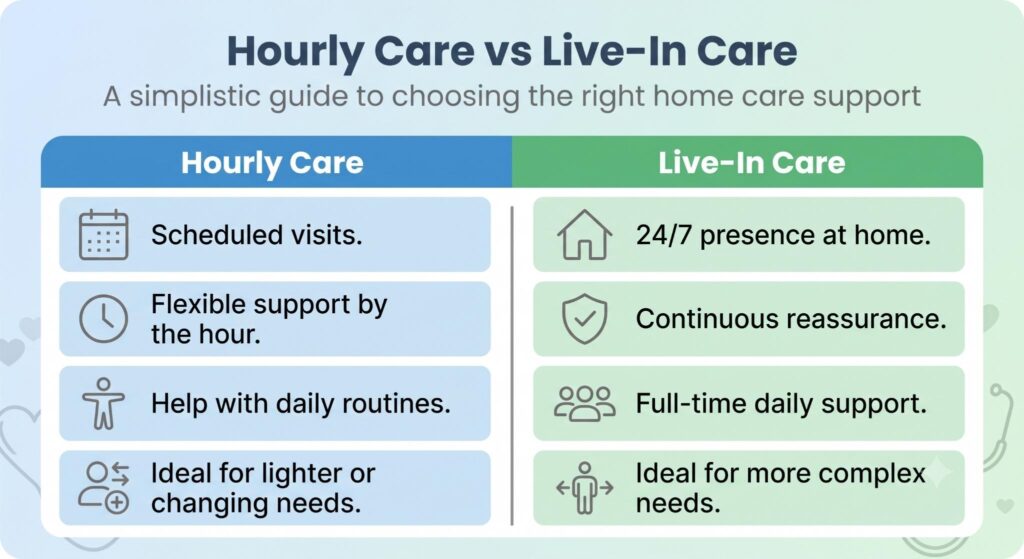
When looking for home care services near me, families generally choose between two primary operational frameworks: visiting care (hourly) and live-in care. Understanding the practical differences between these models is critical to identifying the safest option for your family.
Hourly Domiciliary Care
Hourly support is the most common form of care. Carers visit the property at pre-scheduled intervals during the day or evening.
- Best Suited For: Individuals who require assistance at specific peak times—such as an hour in the morning to assist with bathing and breakfast, a midday safety check, or an evening visit to prepare dinner and manage medication.
- Key Advantage: Exceptional flexibility. The care package can scale up seamlessly from a couple of hours a week to multiple visits per day as an individual’s care needs evolve over time.
Live-In Care Services
For individuals facing more advanced, progressive health challenges or those requiring continuous supervision, live-in care services provide a direct alternative to residential care homes. Under this model, a dedicated, carefully matched professional support worker moves into the client’s home.
- Best Suited For: Individuals with advanced progressive illnesses, high fall risks, acute overnight confusion, or couples who wish to stay together but can no longer manage independent household safety.
- Key Advantage: Unrivalled continuity of care. Having a single, consistent carer allows a deep relationship to form, enabling the worker to spot subtle changes in health or mood far more quickly than visiting staff.
- Operational Requirement: The homeowner must provide a suitable, private bedroom for the live-in care worker, along with access to standard bathroom and kitchen facilities.
3. Specialised Care at Home: Meeting Complex Medical and Cognitive Needs
Modern domiciliary care is no longer limited to basic domestic help. Advancements in regulatory standards and specialised workforce training mean that highly complex medical, behavioural, and cognitive conditions can now be managed safely in a home environment.
In-Home Dementia Care and Memory Support
Caring for a family member with Alzheimer’s or other forms of dementia requires unique patience, structured communication techniques, and specific environmental awareness. Dementia care at home focuses heavily on minimising distress, preserving familiar daily routines, and managing behavioural changes.
Specialised memory care involves:
- Validating and Reassuring: Avoiding confrontational corrections when a client is disoriented, using clear phrases to de-escalate anxiety or confusion.
- Maintaining Sensory Environments: Reducing loud ambient noises or chaotic lighting that can trigger sundowning symptoms or distress.
- Cognitive Stimulation: Introducing structured, brain-stimulating games, life-story work, photo reminiscence, and tailored creative exercises.
Complex Health Needs and Physical Disability Support
For individuals living with severe physical disabilities, neurological conditions (such as Motor Neurone Disease, Multiple Sclerosis, or advanced Parkinson’s), or profound learning disabilities, care packages require close clinical oversight.
This tier of domiciliary care frequently includes handling complex mobility challenges, assisting non-verbal clients with alternative communication strategies, and coordinating with community multidisciplinary teams. Managing self-injurious or challenging behaviours safely demands highly specialised care plans that balance strict risk management with dignity and community inclusion.
Respite Care at Home: Vital Support for Family Carers
Acting as a full-time, unpaid carer for an ageing parent or disabled sibling is an incredibly rewarding but physically and emotionally draining responsibility. Respite care at home provides essential, structured breaks for regular family carers.
Whether it is a planned three-hour block every Tuesday afternoon to allow a primary carer to look after their own health, or emergency overnight coverage to handle an unexpected event, respite services protect families from burnout while ensuring the client experiences minimal disruption to their established routine.
4. Financial Planning: How Much Does Home Care Cost?
Navigating the financial landscape of social care is one of the most stressful aspects of the journey for British families. “What are my home care funding options?” and “how much does home care cost?” are two of the most critical questions you will need to answer.
Average Domiciliary Care Fees in the UK
The cost of home care is never flat; it depends heavily on your geographical location, the frequency of visits, and the specific clinical complexity of the care package.
- Hourly Care Rates: Typically range from £22 to £35+ per hour. Specialised clinical visits or bank holiday support often carry premium rates.
- Live-In Care Rates: Generally start from £1,200 to £1,800+ per week for a single client, scaling upward if the carer is supporting a couple or managing highly complex medical needs.
Understanding Home Care Funding Options
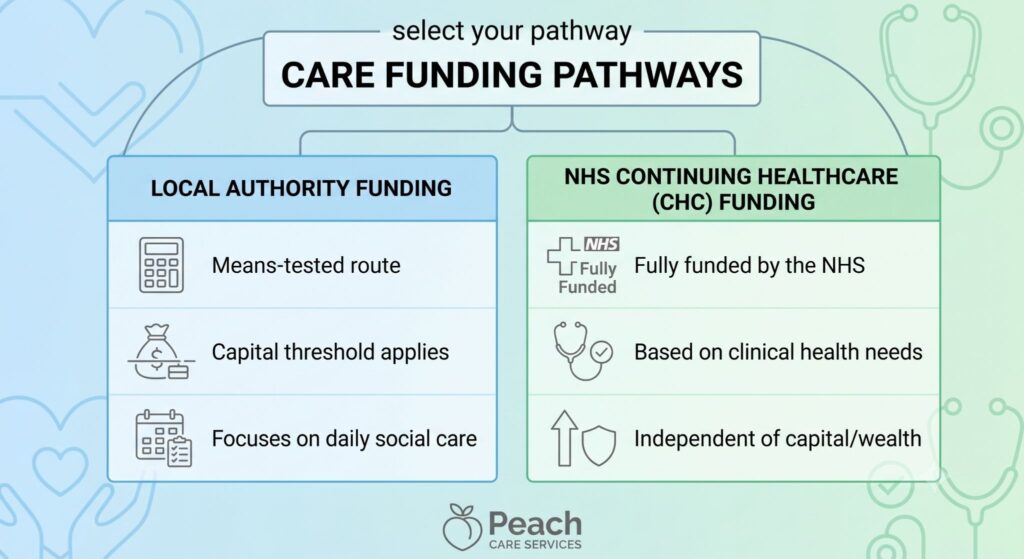
In the UK, care funding is divided into two main categories: state-funded care (via the local authority or NHS) and private-pay funding (self-funding).
1. Local Authority Social Services Funding
To access financial support from your local council, the individual requiring care must undergo a two-step evaluation process:
- The Care Needs Assessment: A local social worker assesses the individual’s physical and cognitive ability to manage daily living tasks safely. If they meet the eligibility criteria, the council agrees that a care package is required.
- The Financial Means Test: The council examines the individual’s capital, savings, and income.
- Note: Unlike residential care home assessments, the value of the individual’s primary property is not included in the means test for domiciliary care, as they will continue living in it.
- If their savings fall below the local capital threshold, the council will fully or partially fund the care package, often routing it through a Personal Budget or Direct Payments so the family can retain control over selecting their own agency.
2. NHS Continuing Healthcare (CHC) Funding
If an individual’s primary need for care is driven by complex, intense, or unpredictable medical conditions (rather than standard social care needs), they may be eligible for NHS Continuing Healthcare (CHC) funding.
CHC is fully funded by the NHS, meaning care is delivered entirely free of charge to the individual, completely independent of their personal savings or financial status. Accessing CHC requires a comprehensive, multi-agency clinical assessment using a specialised National Framework Checklist.
3. Private Funding (Self-Funding)
Individuals whose capital and savings sit comfortably above the local authority threshold are classified as self-funders. Self-funders manage their care contracts directly with private home care agencies, giving them absolute freedom over choosing their provider, scheduling visit times, and setting specific care parameters without local council restrictions.
5. How to Choose the Best Private Carers Near Me: A Step-by-Step Checklist
When searching online for private carers near me or a domiciliary care agency, the sheer volume of search results can feel overwhelming. To protect your family and ensure your loved one receives safe, compliant support, follow this structured evaluation checklist.
Step 1: Verify Regulatory Compliance (The CQC Rating)
In England, all professional domiciliary care agencies must be registered, inspected, and regulated by the Care Quality Commission (CQC). Equivalent bodies operate in Scotland (Care Inspectorate) and Wales (Care Inspectorate Wales).
- Never work with an unregulated agency that cannot provide their official CQC registry profile.
- Review their latest inspection report closely. Look for an overall rating of “Good” or “Outstanding.” Pay specific attention to the “Safe” and “Well-Led” evaluation sub-categories.
Step 2: Fully Managed Provider vs. Introductory Platform
Understand the legal and operational structure of the business you are hiring:
- Fully Managed Service Providers: These agencies employ their carers directly. They handle all reference checks, background checks, Enhanced DBS (Disclosure and Barring Service) checks, ongoing training, holiday/sickness cover, and assume full legal and clinical accountability for updating care plans.
- Introductory Agencies/Platforms: These platforms act as a directory matching you with independent, self-employed carers. While hourly rates can sometimes appear lower, the family takes on the legal responsibilities of an employer, including arranging emergency backup coverage if the carer falls ill.
Step 3: Conduct a Rigorous Care Interview
When meeting a potential care manager for an initial home assessment, ask these critical operational questions:
- How do you handle staff training for specialised conditions like advanced dementia or complex behavioural management?
- What specific electronic logging tracking systems do you use to ensure carers arrive on time and log completed medication prompts?
- How do you manage emergency cover if our regular support worker is off sick or stuck in traffic?
- Can your staff use their own vehicles to provide community transport for appointments or social activities?
- How regularly do you formally review and update the client’s care plan alongside social workers and family members?
6. The Transformative Benefits of Choosing Care at Home
Opting for professional domiciliary care services extends far beyond simple physical safety; it has a profound, measurable impact on the emotional health and dignity of everyone involved.
Preserving Emotional Stability and Independence
Moving an older adult—especially someone navigating cognitive decline—out of their long-term home can trigger severe disorientation, distress, and accelerated physical decline. Home care allows them to sleep in their own bed, keep their pets, sit in their own garden, and remain surrounded by decades of personal memories. This sense of continuity is a powerful anchor for psychological well-being.
Completely Tailored, Person-Centred Care
In a residential care home, staff must divide their attention across dozens of residents simultaneously, operating on rigid institutional schedules for meals, waking, and sleeping.
Domiciliary care is uniquely person-centred. During a care call, the support worker’s focus is entirely on one individual. If a client wants to sleep late, eat breakfast at noon, or spend an afternoon looking through old photo albums, the care plan adapts entirely to them.
Reclaiming Your Family Dynamic
When a family member is forced to act as a primary clinical carer, the natural dynamics of the relationship can easily break down under the strain of physical exhaustion and stress. You stop feeling like a daughter, son, or sibling and start feeling like an un-badged nurse.
By passing core personal care, mobility handling, and medication management to trained professionals, you can step back into your natural role. Your visits can return to being quality time filled with meaningful conversation, shared meals, and emotional connection, safe in the knowledge that your loved one’s practical health needs are being expertly managed.
7. Frequently Asked Questions (FAQs) About Domiciliary Care
What is the precise difference between a care home and home care?
A care home requires an individual to permanently move into a residential facility where accommodation, meals, and communal support are provided collectively. Home care services allow the individual to remain living in their private residence, with professional carers visiting their property at scheduled intervals to deliver personalised support.
Can domiciliary care be arranged rapidly in an emergency?
Yes. Many fully managed agencies maintain dedicated emergency assessment protocols to support rapid hospital discharges or handle sudden changes in family circumstances (such as a primary family carer being suddenly hospitalised). Emergency care plans can often be safely mobilised within 24 to 48 hours of an initial enquiry.
How do home care agencies guarantee client safety and security?
Regulated agencies enforce strict security measures. Carers undergo rigorous reference checks and Enhanced DBS background checks before entering any home. Operationally, agencies utilise secure, encrypted key safes installed on the exterior of the property, allowing authorised staff access without compromising the home’s security.
What happens if our assigned carer does not get along with my loved one?
A high-quality provider understands that care is deeply personal and relies on a strong human connection. If a specific staff pairing does not click naturally, you should speak directly with your care manager. A managed agency will review your preferences and smoothly transition a different, more suitably matched support worker into the rotation without any gap in your care coverage.
Conclusion: Taking the First Step Toward Peace of Mind
Arranging care for a vulnerable family member is a journey that requires equal measures of logistical clarity and emotional empathy. By understanding your home care funding options, prioritising regulated CQC providers, and selecting a tailored care structure, you can build a safe, empowering environment that honours your loved one’s independence.
Do not wait for a health crisis or a fall to force your hand. Initiating a conversation early, exploring local options, and setting up targeted domiciliary support is the single best way to ensure your loved one continues to live a rich, dignified, and independent life in the place they love most: home.