
Introduction
Two young people are sitting in the same lounge. One is flapping their hands and humming. The other is tapping the arm of the sofa, again and again, counting under their breath. From across the room, both look like “repetitive behaviour”. Inside, they could not be more different.
When it comes to stims vs compulsions, the behaviour itself rarely tells you the answer. The feeling behind it does. One young person may be calming their body or expressing joy. The other may be trapped, terrified that something awful will happen if they stop.
Getting this right is one of the most important skills in supporting young people with ASD and OCD. Stop a stim, and you take away a way of coping. Join in with a compulsion, and you may feed the anxiety that drives it. This guide gives you simple questions, real-life scenarios, a decision tree and calm words you can use on shift.
📌 Part 2 of our 5-Part Special Series: Navigating ASD & OCD in Young People
- ✅ Part 1: Understanding the Connection & Care Networks
- 📍 Part 2: Stims vs Compulsions: Decoding Behaviours (You are here)
- ✅ Part 3: Taming the Contamination Storm & Sensory Overload
- ✅ Part 4: Crisis Communication & Verbal De-escalation Scripts (Coming next)
- ⏳ Part 5: Multi-Agency Synergy: CAMHS, Social Care & Care Teams
A quick note before we start: this guide is for learning and day-to-day practice. It does not replace a young person’s care plan, positive behaviour support plan or advice from their clinical team.
1. Stims vs Compulsions: Same Look, Different Engine
A stim (self-stimulatory behaviour) is something an autistic person does to regulate their senses or emotions. Rocking, flapping, spinning, humming, lining things up or rubbing a soft fabric are all common. Stims often feel good. They can calm a busy nervous system, help with focus or simply show happiness.
A compulsion is part of the OCD cycle. It is an action, or a mental act, that a person feels they must do to stop an intrusive thought or to prevent something bad happening. Compulsions bring short-term relief, but they keep the OCD going. Over time, the rules usually get stricter and take up more of the day. The NHS explains the OCD cycle clearly if you would like to read more.
The tricky part? The same action can be either one. Tapping, checking, arranging or repeating words can be a joyful stim for one young person and a fearful compulsion for another. It can even be both for the same young person on different days.
The Comfort Engine vs the Worry Engine
Here’s an easy way to remember it. Every repetitive behaviour has an engine underneath.
- A stim runs on the Comfort Engine: It soothes, grounds or delights. The goal is to feel balanced.
- A compulsion runs on the Worry Engine: It is fuelled by fear. The goal is to make the panic stop, and the relief never lasts long.
Your Stims vs Compulsions Cheat Sheet
| Comfort Engine (stim) | Worry Engine (compulsion) | |
|---|---|---|
| Why they do it | To enjoy a feeling, sound or movement, or to calm down | To stop a “bad thing” happening |
| How it seems to feel | Soothing, safe, absorbing | Stressful, trapped, exhausting |
| If it is interrupted | Frustration, and real distress if it was holding back overload | Panic, or a need to start again from the beginning |
| Over time | Fairly steady | Often grows: more rules, more time |
| Care team goal | Protect it and keep them safe | Stay calm, don’t join in, follow the clinical plan |
The Four-Question Check
When you notice a repetitive behaviour, pause and quietly ask yourself these four questions:
- How do they look while doing it? Relaxed, absorbed or happy points towards a stim. Tense, rushed, tearful or “stuck” points towards a compulsion.
- Is there a fear behind it? If the young person says or shows that something bad will happen if they stop, think compulsion. Words like “I have to”, “it’s not right yet” or “something will happen” are strong clues.
- What happens if it is interrupted? A stim interrupted often brings frustration or a need to restart a routine, and sometimes real distress if the stim was keeping sensory overload at bay. A compulsion interrupted often brings rising panic, distress or a need to start again from the beginning.
- Is it growing? Stims tend to stay fairly stable. Compulsions often grow: more repetitions, stricter rules, more time lost and more people pulled in to help.
No single answer settles it. Look at the whole picture, over time, and share what you notice with the team.
Watch Out for the Grey Areas
- “Just right” feelings: Some young people repeat an action until it feels right, without a clear fear. This can sit in either camp, so record it carefully.
- Tics: Sudden, quick movements or sounds that are hard to hold back may be tics, not stims or compulsions. Tics are more common in young people with autism or OCD and need a clinician’s view.
- Stims that cause harm: Head-banging, biting, or skin-picking can be a form of regulation, but safety comes first. These should be managed through the young person’s positive behaviour support (PBS) plan, never by simply stopping them.
2. Stims vs Compulsions in Real Life: Decoding Behaviours in the Moment
These examples are made up, but they are based on situations care teams meet every week.
Scenario A: The Light Switch
Sam, 14, flicks the bedroom light switch on and off before bed. On a calm evening, he smiles, watches the light and stops after a few goes. On a stressful evening, he flicks it exactly 12 times, starts again if he loses count, and says, “If I don’t, Mum will get ill.”
Decoded: The calm version looks like a sensory stim. The stressful version has a clear fear and a rule, so it is behaving like a compulsion. Same switch, different engine.
Good response: On calm nights, leave it be. On anxious nights, stay calm, don’t count along with him and don’t promise Mum will be fine. Record what you saw and share it with the team and his clinician.
Scenario B: The Lined-Up Cars
Amira, 11, spends an hour lining up toy cars by colour after school. When a staff member knocks one over, she is cross for a minute, puts it back and carries on humming.
Decoded: This looks like an autistic routine and a special interest. It brings her joy and helps her wind down after a busy school day.
Good response: Protect this time. Give a warning before it needs to end (“Five more minutes, then tea”), and use a visual timer if it helps.
Scenario C: The Hand-Washing
Leo, 16, washes his hands for several minutes after touching door handles. His skin is getting red and sore. He asks staff again and again, “Are my hands clean now? Are you sure?”
Decoded: The fear of germs, the repeated reassurance-seeking and the harm to his skin all point to an OCD compulsion. Reassurance feels kind, but it often keeps the cycle going.
Good response: Answer once, kindly, then gently stop repeating it: “I’ve answered that one. I can see the worry is loud right now. Let’s sit together for a minute.” Agree with his clinical team on how the whole staff team will respond, so everyone does the same thing.
Scenario D: The Rocking Chair
Jess, 13, rocks hard in her chair during a noisy family visit. She covers her ears and looks distressed.
Decoded: This is likely a stim used to cope with sensory overload, not a compulsion. The distress comes from the noise, not from a fear she is trying to neutralise.
Good response: Don’t stop the rocking. Reduce the noise, offer ear defenders or a quiet space, and let her body settle.
3. A Simple Decision Tree for Stims vs Compulsions
When you are unsure, work down these three questions in order. Safety always comes first.
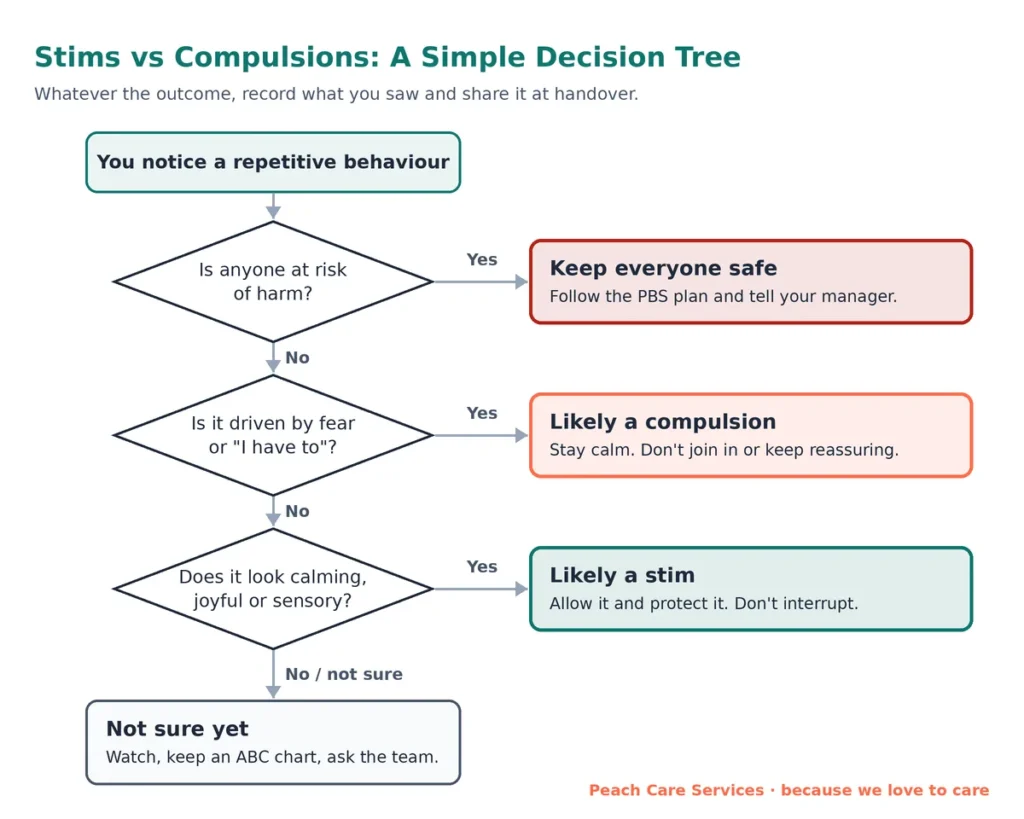
If the answer keeps changing from day to day, that is useful information too. Record it and bring it to the next team meeting.
4. Stims vs Compulsions Scripts: What to Say in the Moment
Short, calm and literal words work best. Pick the script that matches what you are seeing.
| What you see | ❌ Avoid saying | ✅ Try saying | Why it helps |
|---|---|---|---|
| A happy or calming stim | “Stop that, people are looking.” | Nothing at all, or “You look relaxed.” | Shows the stim is safe and accepted. |
| A stim that needs to pause (e.g. crossing a road) | “Hands down!” | “Hands on the buggy for now. You can flap again on the grass.” | Gives a clear reason and a time it can return. |
| Sensory overload in public | “Calm down, you’re making a scene.” | “Your body needs big movements right now. Let’s find a quieter spot together.” | Names the need and offers a way out. |
| Repeated reassurance-seeking | “I’ve told you ten times, you’re fine!” | “I’ve answered that one. I’m here with you while the worry passes.” | Stays warm without feeding the Worry Engine. |
| Distress mid-ritual | “Just stop thinking about it.” | “I can see OCD is being really loud. You’re safe. Let’s take two slow breaths together.” | Separates the young person from the OCD. |
| Asking you to join a ritual | “Fine, I’ll check it for you.” | “I’m not going to do that part, but I’m staying right here.” | Kind, steady and consistent with the plan. |
Two golden rules: Never shame, mock or punish a stim or a compulsion. And never make up a new rule on the spot. If you are unsure, stay calm, keep everyone safe and check the care plan.
5. Record It, Share It, Stay Consistent
When it comes to stims vs compulsions, one shift rarely tells the whole story. Good records turn a guess into a pattern that clinicians can work with.
An ABC chart is a simple way to start:
- A – Antecedent: What happened just before? (A noise, a change of plan, touching a door handle.)
- B – Behaviour: What did you see and hear, word for word if possible? How long did it last?
- C – Consequence: What happened next, and how did the young person seem afterwards: calmer, or still stuck?
Add how many times it happened and anything the young person said about why. Share patterns at handover and in team meetings.
Consistency matters more than perfection. If one carer joins in with a ritual and another refuses, the young person learns that the rules keep changing. That uncertainty raises anxiety. Agree on one approach as a team, write it into the care plan and follow it on every shift.
When to Ask for Specialist Help
Speak to your manager, and through them the young person’s GP, CAMHS team or clinician, if:
- Rituals are taking up more than about an hour a day, or getting longer.
- The young person is missing school, meals, sleep or time with others because of them.
- There is physical harm, such as sore skin from washing or injuries from a stim.
- The young person is very distressed, withdrawn or talks about hurting themselves.
The recommended treatment for OCD in young people is a type of cognitive behavioural therapy (CBT) called exposure and response prevention (ERP). It should be led by a trained clinician and adapted for autistic young people. Care teams play a vital supporting role, but should not start exposure work on their own.
6. Why This Matters for Ofsted and CQC
Spotting stims vs compulsions is not just good practice. It is exactly what inspectors look for. In children’s homes in England, Ofsted inspects against the nine Quality Standards in the Children’s Homes (England) Regulations 2015. Here is how this guide links to five of them:
| Ofsted Quality Standard | What it looks like in practice |
|---|---|
| Positive relationships (Reg 11) | Staff understand each young person’s communication, including what their stims mean. |
| Protection of children (Reg 12) | Distress is managed calmly and safely, through the PBS plan, without taking away healthy ways of coping. |
| Enjoyment and achievement (Reg 9) | Special interests and joyful stims are protected, and OCD is not allowed to shrink a young person’s world. |
| Health and well-being (Reg 10) | Patterns are recorded and shared, so CAMHS and GPs can offer the right treatment at the right time. |
| Children’s views, wishes and feelings (Reg 7) | Young people are asked how a behaviour feels to them, and their answers shape the plan. |
Supported accommodation for 16 and 17-year-olds has its own Ofsted standards, with the same focus on relationships and safety. For young adults supported in their own homes, the same approach shows CQC strong evidence of person-centred, safe and caring support.
The Bottom Line
You don’t need to be a psychologist to get stims vs compulsions right. You need curiosity, calm and a team that pulls in the same direction. Ask what is driving the behaviour. Protect the Comfort Engine. Don’t feed the Worry Engine. Write it down and share it.
Do that, shift after shift, and young people learn something powerful: the adults around them truly understand them. That is where confidence, trust and progress begin.
What’s Coming Up in Part 3?
Now you can tell a stim from a compulsion; the next challenge is the moment they collide. In Part 3: Taming the Contamination Storm & Sensory Overload, we look at what happens when germ fears meet a highly sensitive nervous system. You’ll get practical ideas for bathrooms, laundry, mealtimes and shared spaces, plus how to support hygiene without feeding the OCD.
Don’t miss the next instalment! Bookmark this page or subscribe to our Newsletter below to get Part 3 straight to your inbox next week.
Supporting a young person with complex needs? Our specialist team in Milton Keynes, Kettering and West Sussex is here to help. Get in touch with our team today.